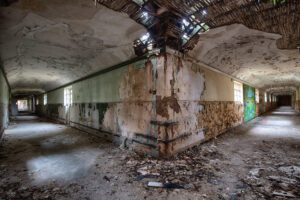
Location: Aldershot, Hampshire, UK
Date of Visit: 3rd August 2026
Explored with Aston & TrevBish
The History of Browning Barracks – Aldershot
Browning Barracks formed part of Aldershot Garrison, the historic home of the British Army and one of the world’s oldest purpose-built military towns. Since the 1850s, Aldershot has been at the heart of British military training, with generations of soldiers living, training and deploying from the town before serving around the world.
The barracks themselves were built during the 1960s as part of a major modernisation programme that transformed Aldershot Garrison. Much of the ageing Victorian military estate was demolished and replaced with modern accommodation and training facilities designed around the needs of a post-war army. Browning Barracks, named after General Sir Frederick “Boy” Browning, commander of the British Airborne Forces during the Second World War, became the new home of the Depot of the Parachute Regiment when it relocated from Maida Barracks in 1968.
For more than two decades, Browning Barracks was where thousands of recruits began their careers in the Parachute Regiment. The depot handled recruit training, administration and support for Britain’s airborne forces, while the famous Red Devils parachute display team was also based here. The site remained closely associated with the Regiment until army-wide training changes in the early 1990s saw the depot move elsewhere.
The barracks were also home to the Parachute Regiment and Airborne Forces Museum, officially opened by Field Marshal Bernard Montgomery in 1969. The museum displayed everything from D-Day briefing models and Arnhem artefacts to aircraft, vehicles, weapons and one of the country’s finest collections of airborne memorabilia. It remained at Browning Barracks until relocating to the Imperial War Museum at Duxford in 2008, where it continues today as Airborne Assault.
Following the military’s departure, Browning Barracks became surplus to requirements. Today, like many former military sites across Aldershot, it forms part of the ongoing regeneration of the town, with the former barracks gradually disappearing to make way for new housing. Before redevelopment is complete, however, the site still offers a fascinating glimpse into the more recent history of Britain’s armed forces and the evolution of the Home of the British Army.

A Quick Evening Explore
Having noticed redevelopment work had already started on the site, we decided to make a quick evening trip over before it disappeared completely. Joining me were Trevbish and Aston, and with demolition seemingly getting underway, we weren’t expecting there to be much left to see.
Access turned out to be surprisingly straightforward.
Although construction equipment was already present around the site, there were no security guards, warning signs or obvious attempts to secure the remaining buildings. Within minutes we were wandering through what remained of another piece of Aldershot’s military history.
Inside Browning Barracks
It quickly became apparent that most of the site had already been stripped.
The accommodation blocks were largely empty, with little left behind other than bare rooms, long concrete corridors and the occasional reminder of their former purpose. After exploring a couple of buildings, the layout became quite repetitive, and much of the barracks felt very similar from one block to the next.
Despite that, there were still a few interesting discoveries.
The Officers’ Mess was undoubtedly the highlight of the explore. Unlike the standard accommodation, it retained a little more character and gave a better impression of what the site might once have looked like during its operational years.
Elsewhere we found evidence suggesting parts of the barracks had been used for military police training, medical instruction and live firing exercises. Civil Defence notices, range markings and radiation warning signs appeared throughout several buildings, giving the whole site a distinctly Cold War atmosphere.
The architecture itself reflected exactly what you’d expect from a military installation of the period. Large reinforced concrete structures, functional layouts and minimal decoration gave everything a stark, institutional feel. It wasn’t beautiful architecture, but it certainly captured the military design philosophy of the 1960s.
One thing that couldn’t be ignored was the amount of asbestos still present throughout the site. Warning labels remained in several areas and it was obvious that specialist removal work would be required before demolition could continue. As always, we took care not to disturb anything, sticking to documenting the buildings through photography.

Final Thoughts
If I’m honest, Browning Barracks wasn’t the most exciting military explore we’ve ever done.
By the time we visited, most of the buildings had already been stripped, and many of the accommodation blocks felt repetitive. There were no hidden treasures or spectacular finds waiting around the next corner.
But that’s not always what urban exploration is about.
Sometimes it’s simply about recording a place before it disappears forever.
The Officers’ Mess, the Cold War Civil Defence signs and the firing range areas were enough to make the trip worthwhile, and it was interesting to see another part of Aldershot’s military history before redevelopment changes the landscape once again.
Not every explore has to be extraordinary.
Sometimes a couple of hours wandering around with friends, cameras in hand and another forgotten military site to document is more than enough. Before long, Browning Barracks will almost certainly be gone, replaced by new homes, leaving little trace of the role it once played within Britain’s largest military garrison.
And that’s exactly why it’s worth photographing these places while we still can.