There are nights when astrophotography goes exactly to plan.
And then there are nights when you climb a massive hill in the dark, get surrounded by sheep, discover your carefully chosen foreground is behind barbed wire, spend the night being eaten alive and finally drive all the way home before realising you’ve left your tripod on top of the bloody hill.
This was one of those nights.
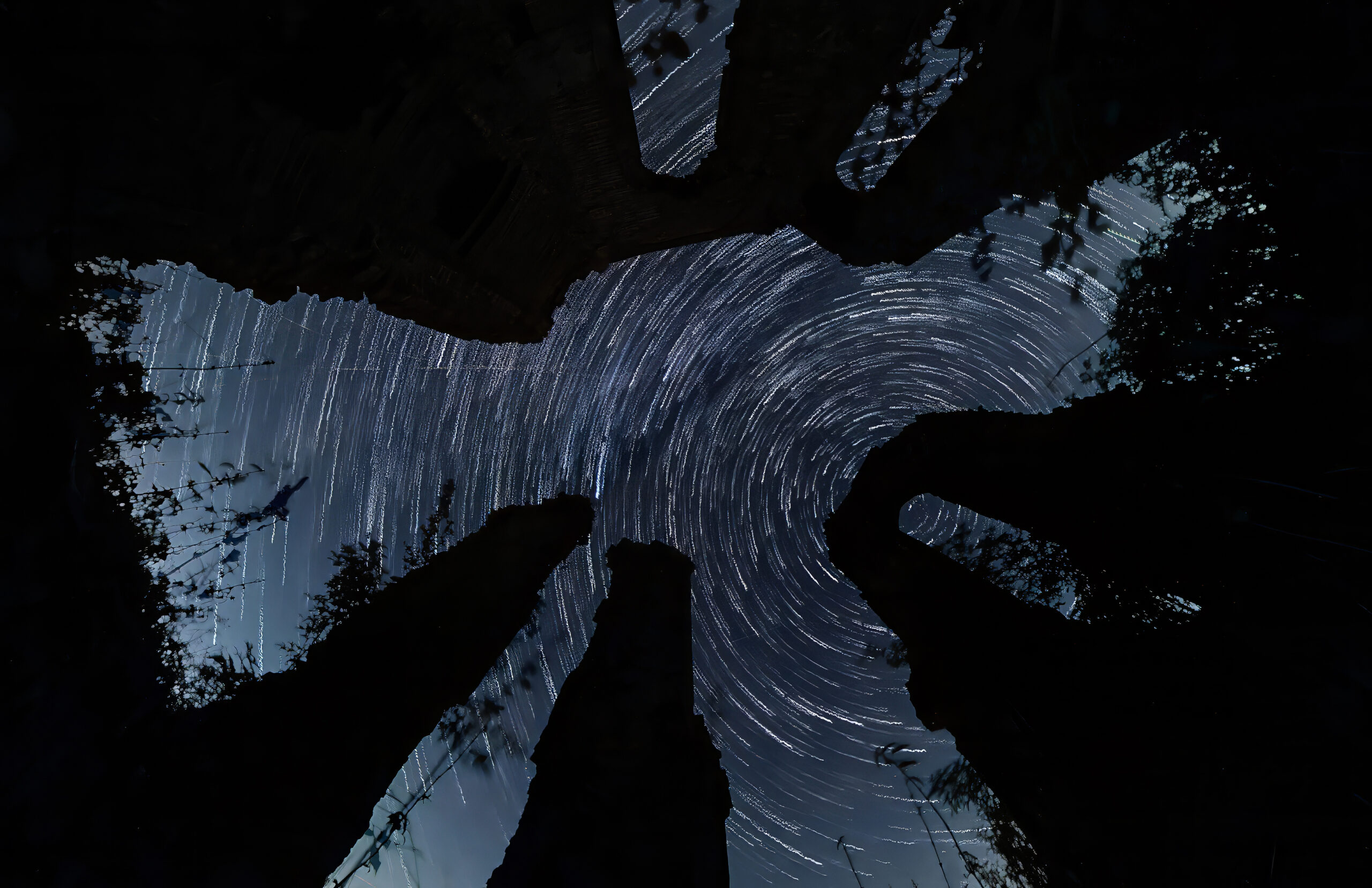
It was also the first proper star trail outing for my new Insta360 X6, and despite everything that happened, it produced exactly the sort of photograph I’d hoped for.
The location was the Vandalian Tower, a strange ruined 18th-century folly standing alone on Tower Hill beside Harting Down in the South Downs.
I’d stumbled across it while looking for interesting foreground subjects for astrophotography. A ruined Gothic tower surrounded by open countryside and relatively dark skies seemed almost too perfect.
Which immediately made me wonder why I’d seen so few night photographs of it.
I was about to find out.

Finding the Vandalian Tower
I’m always looking for something more interesting than an empty horizon when shooting the night sky.
Star trails become considerably more interesting when you’ve got a strong foreground, and old ruins, churches, castles and abandoned buildings are pretty much perfect.
While searching around Harting Down, I spotted the Vandalian Tower.
I’d been around this part of the South Downs plenty of times and somehow had never really noticed it before.
The photographs immediately caught my attention.
Four enormous ruined walls standing alone on top of a hill, pointed Gothic windows looking out across the countryside and virtually nothing surrounding it.
For an Insta360 X6 star trail, it looked brilliant.
So I packed the camera gear and headed for Harting Down.
The Climb to Tower Hill
Getting there was slightly less romantic.
From where I’d parked, it was roughly a 15-minute climb uphill carrying all the camera equipment.
And when I say uphill, I mean uphill.
The landscape around Harting Down is beautiful during daylight, but carrying camera equipment up it while being stared at by several hundred sheep is a slightly different experience.
Eventually the ruined tower appeared on the horizon.
Perfect.
Except for one small problem.
Barbed wire.
The entire ruin was surrounded by fencing.
Suddenly I understood why there weren’t thousands of photographs taken from underneath those Gothic arches.
The Vandalian Tower stands on private land and the surviving structure is protected. Historic England records it as a designated historic monument forming part of the historic Uppark landscape.
So, while it looks incredibly tempting sitting alone on the hill, this isn’t simply another open ruin on the South Downs.
The Strange History of the Vandalian Tower
The story behind the Vandalian Tower is almost as unusual as the building itself.
The tower was designed by architect Henry Keene for Sir Matthew Fetherstonhaugh, owner of nearby Uppark House, in around 1770.
It stood on an existing raised mound at the highest point of the Uppark estate, giving spectacular views across the surrounding countryside and south towards the coast and the Isle of Wight.
It wasn’t simply a decorative ruin.
Originally, this was a proper building.
Constructed from red brick with Gothic pointed windows, hollow corner buttresses and stone pinnacles, the tower contained a kitchen on the ground floor and an upper room or viewing platform reached by an external ramp.
It was somewhere to entertain guests, enjoy the landscape and demonstrate the wealth and status of the Uppark estate.
But its name came from something considerably more ambitious.
The British Colony That Never Happened
Sir Matthew had financial interests in a proposed British territory in North America.
The territory, in an area that included land in what is now West Virginia, was intended to become a new colony called Vandalia.
The tower on his Sussex estate was built in connection with this ambitious colonial project and became known as the Vandalian Tower.
Unfortunately for those involved, history had other ideas.
Sir Matthew died in 1774.
Then, in 1775, the American War of Independence began.
The proposed colony of Vandalia collapsed before it could properly become established.
The tower remained.
A rather extravagant monument to a colony that essentially never happened.
Parties, the Hellfire Club and Uppark
The tower’s elevated and secluded position also became associated with the rather colourful social life surrounding Uppark.
Historic England records the Vandalian Tower as a reputed meeting place of the Hellfire Club, the name associated with several exclusive groups of wealthy 18th-century aristocrats known for drinking, partying and deliberately scandalous behaviour.
Uppark itself later became renowned for lavish entertaining under Sir Harry Fetherstonhaugh, who inherited the estate following his father’s death.
So it’s not difficult to imagine the tower being used for rather more than quietly admiring the Sussex countryside.
The Fire of 1842
The Vandalian Tower survived into the 19th century before disaster struck.
In 1842, the building was badly damaged by fire.
One local account records that the fire was deliberately started by a group of poachers from a neighbouring parish.
Whatever the precise circumstances, the tower was never rebuilt.
The once elaborate viewing pavilion became the skeletal ruin standing on Tower Hill today.
Its surviving structure was eventually stabilised in 1982, preserving the remaining brickwork and Gothic arches.
Today the Vandalian Tower forms part of the historically important landscape surrounding Uppark and remains one of the stranger architectural survivors of the South Downs.

My First Insta360 X6 Star Trail
Historical distractions aside, I’d come here for one reason.
I wanted to see what the Insta360 X6 could do with the night sky.
I’ve become slightly obsessed with using 360 cameras for star trails because they allow compositions that would be extremely difficult to create with a conventional camera.
Instead of committing to a single composition when you press the shutter, you’re effectively recording the entire sky around the camera.
That means I can decide on the exact framing afterwards.
For a location like the Vandalian Tower, that’s incredibly useful.
I could place the X6 close to the ruins, capture the movement of the stars around the tower and then experiment with completely different compositions afterwards.
This was my first serious overnight test of Starlapse on the Insta360 X6.
Insta360 X6 Starlapse Mode
The X6 includes a dedicated Starlapse mode designed specifically for photographing the night sky over long periods.
Rather than recording conventional video continuously throughout the night, the camera captures a sequence of exposures that record the movement of the stars as the Earth rotates.
Those frames can then be combined into a Starlapse video or used to create a static star trail photograph.
For anyone experimenting with Insta360 X6 astrophotography, this is probably one of the most interesting shooting modes on the camera.
The biggest advantage is obviously the 360-degree field of view.
You don’t need to perfectly predict where your final composition will be before darkness falls.
Set the camera up in a strong position, capture the entire sky and worry about the framing afterwards.
Photographing Star Trails Around the Tower
Once darkness arrived, I positioned the X6 low enough to make the tower dominate the foreground while still capturing as much of the night sky as possible.
Then it was simply a matter of letting the camera work.
Star trail photography rewards patience.
The longer you leave the sequence running, the further the stars appear to travel across the sky and the longer the trails become.
What begins as a sky full of individual stars gradually turns into sweeping arcs above the landscape.
And with the ruined Vandalian Tower sitting underneath them, the result was exactly the slightly surreal image I’d had in my head when I first discovered the location.

Camping on Harting Down
Of course, leaving an expensive camera alone on a remote hill for hours isn’t particularly relaxing.
So I stayed nearby for the night.
The good news was that the camera could continue shooting uninterrupted.
The bad news was that apparently every biting insect on the South Downs had also decided to spend the night there.
I got absolutely eaten alive.
Between checking the camera, watching the sky and trying not to become dinner for the local insect population, it wasn’t exactly the peaceful night beneath the stars I’d imagined.
But the X6 kept shooting.
That was the important bit.
The Tripod Incident
Eventually morning arrived.
The camera had survived.
I’d survived.
The star trail sequence looked promising.
I packed everything away, walked back down that enormous hill, got into the van and drove home.
Job done.
Except it wasn’t.
Some time later I realised something was missing.
My tripod.
I’d somehow managed to pack away the Insta360 X6 and the rest of the camera equipment while leaving the tripod sitting on top of Harting Down.
There are few moments quite like realising the thing you’ve forgotten is sitting several miles away on top of a massive hill.
So the following day I drove all the way back.
Then climbed the bloody hill again.
Fortunately, it was still there.
At least this time I had daylight.

Back With the Drone
There was one advantage to making the return journey.
I took the DJI Mini 4 Pro with me.
From ground level it’s difficult to appreciate just how isolated the Vandalian Tower really is.
From the air, it makes considerably more sense.
The ruined Gothic structure sits alone on its mound surrounded by rolling fields and the landscape of the South Downs.
The drone also revealed the shape of the surviving structure far better than you can see from ground level.
And because this is Harting Down, several sheep inevitably made an appearance.
So accidentally leaving the tripod behind at least resulted in a second set of photographs.
That’s what I’m telling myself anyway.
Is the Insta360 X6 Good for Star Trails?
Based on this first proper outing, yes, absolutely.
The Insta360 X6 is an incredibly interesting camera for star trail photography because it completely changes how you approach composition.
With a conventional camera, I’d carefully calculate the position of the stars, choose a focal length and lock myself into one composition for several hours.
With the X6, I can concentrate much more on where I place the camera in relation to the foreground.
The entire sky is being captured around it.
That gives me considerably more freedom when processing the images afterwards.
It’s particularly useful around architecture and ruins, where placing a conventional ultra-wide lens close to the structure can make composition difficult.
For locations like the Vandalian Tower, churches, castles and abandoned buildings, 360-degree astrophotography opens up some genuinely unusual possibilities.
Insta360 X6 Star Trails: What I Learned
This first night also taught me a few things I’ll take into future X6 Starlapse shoots.
Foreground matters enormously.
A technically perfect star trail over an empty field isn’t nearly as interesting as an imperfect one surrounding an unusual building.
Give the camera time.
A short sequence will show movement, but several hours produces dramatically longer and more impressive trails.
Think about the camera position rather than the final crop.
Because you’re shooting in 360 degrees, positioning the X6 relative to the foreground is more important than deciding exactly where the stars will appear in the finished image.
And finally…
Count your equipment before walking back down the hill.
That one may be specific to me.
Final Thoughts
For the first proper Insta360 X6 star trail test, I couldn’t really have chosen a stranger location.
A mysterious ruined Gothic tower built to celebrate an American colony that never happened, sitting alone on top of the South Downs, surrounded by sheep and barbed wire.
Add an overnight Starlapse, hundreds of insect bites, a forgotten tripod and an unexpected second journey with the drone, and it turned into considerably more of an adventure than I’d planned.
But that’s usually how the best photography trips happen.
The Vandalian Tower turned out to be a fantastic foreground for the X6, and this first experiment has definitely convinced me there’s considerably more potential in Insta360 X6 astrophotography and 360-degree star trails than I’d expected.
Now I just need to find the next ruin.
Preferably one that isn’t at the top of an enormous hill.